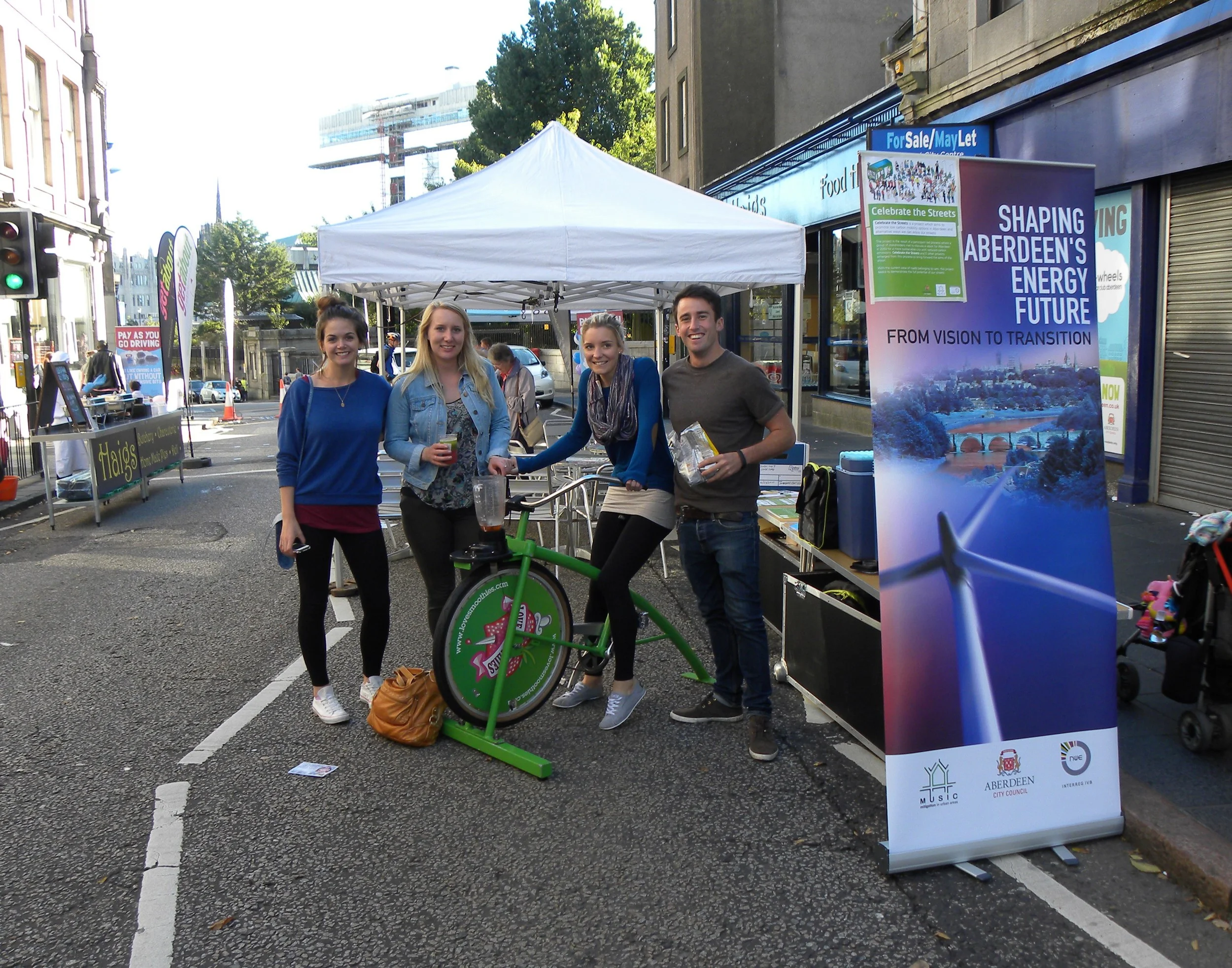
The Dutch Research Institute for Transitions takes us through their transitions management approach to achieving transformative sustainability initiatives, based on their recent experiences with five cities around the world. Representing Scotland was Aberdeen City Council, who undertook a school energy efficiency project and the 'Celebrate the Street' initiative, as well as numerous other projects.
My colleagues are going to hate me for posting this, but ... well, I'm not Elon Musk*, okay? So here's a bit of a beginnings for constraints on the future of renewables. And when I say 'beginnings' I mean 'beginnings'! If one wants to do this properly one needs to start with so-called 'boundary conditions' and work inwards from there.
A report from Scene's free community energy workshops, attended by community groups, councils & civic societies from all over Scotland. A productive introduction to community renewables, where attendees discussed and developed their energy ideas and projects with staff from Scene, Local Energy Scotland and Fintry Renewable Energy Enterprise, amongst others.
Community Energy Fortnight is almost upon us. As part of these promotion of the series of events, in which we are running a workshop. I answered from questions in an interview with Blue and Green Tomorrow.
An approachable bunch of theorists, empiricists, and some practitioners from various fields convened at the 5th International Sustainability Transitions Conference in Utrecht, the Netherlands. Most of the influential thinkers in the field were there, partaking in a carefully designed programme that centered on developments at the fringes of the fields of ‘sustainability transitions’ and ‘technology innovation systems’ research. The programme was a testament to just how much has happened in the last decade since transitions theory was first introduced as a theory of socio-technical change.
We have just returned from Adamawa, Central Northern Cameroon, where we had the opportunity to see first-hand the challenges and opportunities of domestic biogas as a means of providing clean and low-cost energy to remote, off-grid and low income areas. What was most interesting about this visit was to see the motivations for people to engage in renewable energy projects, and the barriers to ownership, compared to those in Europe. This opinion piece looks at the crux of the matter: the often underestimated role of social institutions, and a deep-rooted lack of trust in environments with weak or absent market institutions.
Two weeks ago I attended the launch of Community Energy England (CEE), and was part of a packed 250 strong delegation in Holborn, London. The event was excellent, with speakers from the interim CEE board and a range of practitioners from regional advisory groups and individual projects.
The Government has launched a discussion document aimed at ensuring that local people have the opportunity to gain shares or income from renewable energy developments, but in typically British centralising fashion it is ironic that this discussion seems to focussed on what the electricity majors want or are prepared to allow.
Over 1000 leaders from across the social spectrum assembled for the Clinton Global Initiative meeting (http://www.cgiamerica.org) in downtown Denver this week to address an ambitious set of issues surrounding the stuttering economic recovery in America. Established in June 2011 by President Bill Clinton, CGI America brings together leaders in business, government, and civil society to generate and implement commitments to create jobs, stimulate economic growth, foster innovation, and support workforce development in the United States. Since its first meeting, CGI America participants have made over 300 commitments valued at more than $15 billion when fully funded and implemented.
On Friday 14 February 2014, an EU Consultation on State Aid Rules for Energy closes. The proposed legislation will further disadvantage small renewable generation projects being driven forward by non-specialists, such as community groups and local stakeholders. Below is the response to the consultation I wrote on behalf of Scene.